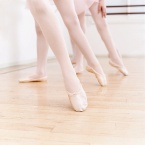
Dance
is an artistic, athletic, expressive, and social form of physical
activity that appeals to a wide variety of individuals. The physical
aspects of dance can be both a valuable source of exercise as well as a
cause of injury. For young people who take dance classes, have formal
training in dance, or perform as dancers, they typically do so in one of
the following dance disciplines: ballet, jazz, modern, tap, hip hop,
Irish, or lyrical.
There are many forms of dance that have unique physical demands and
specific injury risks. There are also some physical demands that are
common to a wide variety of dance forms. For example, many types of
dance involve jumping, turning, toe pointing, back arching, and lifting.
These activities can produce tendinosis, stress fractures, ankle
sprains, ankle impingement, or low back pain.
The following is information from the American Academy of Pediatrics
about common ballet and dance injuries and their symptoms. Also included
are 3 common questions from dancers.
Common injuries
| Flexor hallucis longus tendonitis |
Inflammation of tendon that flexes big toe; tendon is stressed with releve, jumps, pointe work. |
Pain, tightness, and/or weakness along the tendon in arch or behind the inner part of the ankle. |
| Symptomatic os trigonum |
Extra piece of bone behind ankle joint
(found normally in 20% of individuals) gets pinched when the toes are
pointed and ankle is flexed downward. |
Pain, tightness, and occasional swelling behind ankle associated with releve, pointe work, and going up on toes. |
| Anterior talar impingement |
Pinching of soft tissues in front of ankle with ankle bending upward. |
Pain, tightness, pinching sensation in front of ankle with plié, preparing to jump, and landing from jump. |
| Ankle sprain |
The ankle inverts (collapses inward) most commonly when dancers are on their toes while jumping, landing, or turning. |
Pain, swelling on outer ankle; sense of
instability with sideways movement; sprains are more common if there
has been a previous sprain. |
| Stress fracture |
Repetitive impact stress can cause
weakening of bone; often without a visible crack seen on x-ray. Common
in metatarsals (forefoot), tarsals (midfoot), tibia, and fibula (leg)
and occasionally femur, pelvis, and spine. |
Persistent, deep, bony pain associated
with high levels of impact activity; more common in dancers with calcium
or vitamin D deficiency, eating disorders, and menstrual
irregularities. |
| Patellofemoral pain syndrome |
Pain under the kneecap from pressure
associated with knee bending, pliés, jumps; can lead to softening or
thinning of cartilage behind the kneecap. |
Dull, achy anterior knee pain that increases with knee bending, pliés, and jumps. |
| Snapping hip |
Multiple causes including tendon
snapping over front or side of hip; associated with active hip movement;
occasionally due to torn cartilage lining the hip socket but very
unlikely due to dislocating hip. |
Snapping sensation that may or may not be painful;
occasionally, dancer has a sense that the hip is going out of place;
occasionally, there is a catch or pinching sensation deep in joint when
hip is bending. |
| Pars injury |
The pars interarticularis is a part of
the spine that is stressed with back extension (arching); pain or
weakening of the pars most commonly occurs during periods of rapid bony
growth. Injuries to this area may be referred to as spondylolysis, or stress fracture of the spine. |
Tightness, achiness in central part of
the low back that is worse with arching, jumping, running, and lying
prone; better with forward bending; nerve symptoms and radiating pain
are rare with this condition. |
| Disc injury |
Weakening or bulging of lumbar disc; due
to repetitive trunk bending, twisting, or lifting. Athletes may also
get a vertebral end plate (growth plate) injury. |
Low back pain that extends to the flank
or buttock; may spread to thigh; occasional numbness or tingling; worse
with sitting, bending, lifting, and lying down with face up; better
with arching and lying down with face down. |
Frequently asked questions
Q: When can I begin pointe work?
A:
En pointe refers to performing dance steps on the tips of
the toes. This technique is used only by female dancers. Trying pointe
work too soon can lead to risk of sprains, fractures, and growth plate
injuries. Most experts believe that a dancer is ready to try pointe work
when the following criteria are met:
- Age range 9 to 15 years; 12 is average (assuming other criteria below are met)
- Three or more years of classical ballet training; 2 or more
classes/week of preprofessional training (Instructors who have trained
professional dancers can usually determine when a dancer has the
necessary experience, technical skill, and strength to go en pointe.)
- Sufficient bony maturation
- Adequate strength in arch, ankle, leg, hips, trunk muscles
- Adequate balance and control
- Adequate supervision and training, including carefully graded skill progressions and monitoring
Q: Can I improve my turnout?
A:
Turnout refers to the ability to externally rotate the
hip. Not all dancers can achieve optimal turnout because they may be
limited by their bony anatomy. For example, the depth and angle of a
dancer’s hip socket may affect how far he or she can rotate his or her
hip. However, most dancers can improve their turnout with appropriate
exercises. For example, turnout can be improved by stretching the hip
joint and the muscles on the inner side of the hip joint.
Optimal turnout allows dancers to stand with their feet pointing
opposite directions while their knees are positioned directly over the
feet. If turnout is not done correctly, dancers are either unable to
hold this position or they “cheat” by twisting their knees or forcing
their lower legs to the outside. When the hip, knee, and foot are not in
alignment, leg and low-back injuries can occur.
Q: How can I safely lose weight?
A: Dancers of all ages face tremendous pressure to be thin. The
pressure may be based on aesthetic or performance requirements. At
times, targeted weight goals may be unhealthy. Not getting enough
calories and nutrients can contribute to less energy, impaired brain
functioning (like poor concentration), and increased risk of illness and
injury. When unsafe weight loss practices are used to reach a desired
appearance, health risks can include serious illness, hospitalization,
and even death.
Dancers who want to lose weight should use a medically supervised
strategy. This includes working with a medical professional to determine
how much weight loss is safe, how quickly the weight can be lost and
how nutritional and energy requirements will be met. It may also be
helpful to work with a registered dietitian. It is essential to have
regular medical monitoring to evaluate the safety and efficacy of the
weight loss program.
For answers to additional questions about injuries, injury
prevention, and safe training practices, talk with your doctor or a
physical therapist.